Khidmat: A Scientist’s Journey of Service
By Insiyah Parekh, London, UK
As a virologist working with mosquitoes, my research is grounded in a truth revealed over 1,400 years ago in Surah Al-Baqarah (2:26):
“Indeed, Allah is not shy to present an example—that of a mosquito or what is greater than it…”
The mosquito—light enough to go unnoticed—can carry viruses capable of altering human history. Its small size is a humbling reminder of the fragility of life and the vastness of Allah’s creation.
Today, the global health landscape is shifting. Climate change, wildlife migration, and rapid travel are enabling the spread of arthropod-borne viruses—those transmitted by mosquitoes and ticks—into new regions.
In Europe, repeated introductions of West Nile virus and Usutu virus have been linked to bird migration from Africa. Outbreaks of chikungunya and dengue have followed the movement of infected travelers, while invasive species like Aedes albopictus have been detected in southern England.
Warmer summers now create conditions in which UK mosquitoes could potentially transmit viruses such as Japanese Encephalitis—something that was impossible just decades ago.
At the Animal and Plant Health Agency (APHA), where I contribute my expertise, our team serves as the UK’s National Reference Laboratory for mosquito-borne viruses. We investigate vector competence, monitor emerging pathogens, and model how temperature shifts might influence transmission.
It is meticulous, sometimes painstaking work—yet each dataset and field observation has one purpose: to protect life.
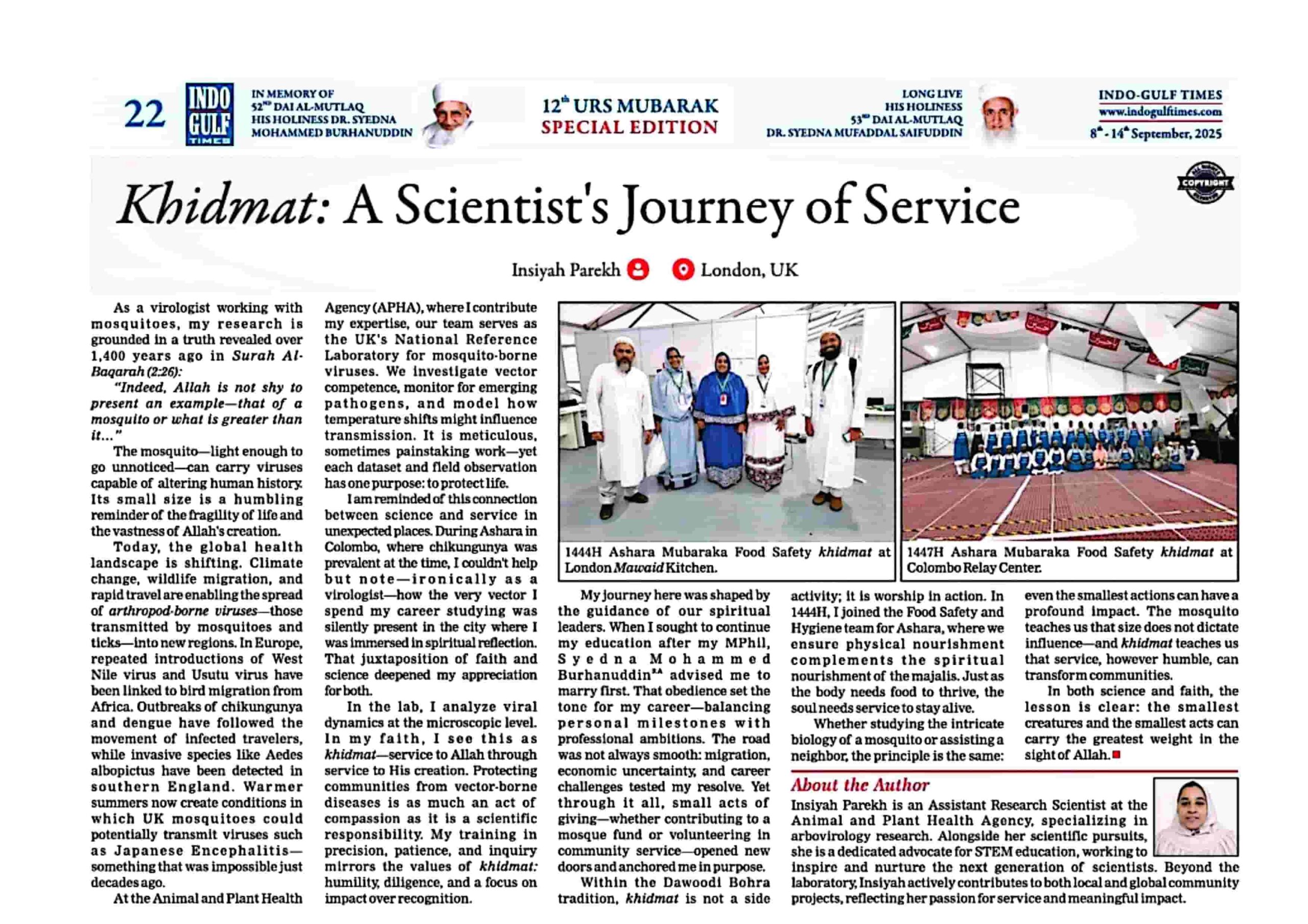
I am reminded of this connection between science and service in unexpected places. During Ashara in Colombo, where chikungunya was prevalent at the time, I couldn’t help but notice—ironically as a virologist—how the very vector I spend my career studying was silently present in the city where I was immersed in spiritual reflection.
That juxtaposition of faith and science deepened my appreciation for both.
My journey here was shaped by the guidance of our spiritual leaders. When I sought to continue my education after my MPhil, Syedna Mohammed Burhanuddin advised me to marry first.
That obedience set the tone for my career—balancing personal milestones with professional ambitions.
The road was not always smooth. Migration, economic uncertainty, and career challenges tested my resolve. Yet through it all, small acts of giving—whether contributing to a mosque fund or volunteering in community service—opened new doors and anchored me in purpose.
Within the Dawoodi Bohra tradition, khidmat is not a side activity; it is worship in action.
In 1444H, I joined the Food Safety and Hygiene team for Ashara, where we ensure that physical nourishment complements the spiritual nourishment of the majalis.
Just as the body needs food to thrive, the soul needs service to stay alive.
Whether studying the intricate biology of a mosquito or assisting a neighbor, the principle is the same: even the smallest actions can have a profound impact.
The mosquito teaches us that size does not dictate influence, and khidmat teaches us that service, however humble, can transform communities.
In both science and faith, the lesson is clear:
The smallest creatures and the smallest acts can carry the greatest weight in the sight of Allah.
About the Author
Insiyah Parekh is an Assistant Research Scientist at the Animal and Plant Health Agency, specializing in arbovirology research.
Alongside her scientific pursuits, she is a dedicated advocate for STEM education, working to inspire and nurture the next generation of scientists.
Beyond the laboratory, Insiyah actively contributes to both local and global community projects, reflecting her passion for service and meaningful impact.